

Anthropic released Claude Fable 5.2 and Claude Mythos 5.2 on November 9, 2026. They're one model with two sets of safeguards. They answer up to 30% faster than the 5.1 versions, and the price drops 20% to $8 per million input tokens and $40 per million output tokens. Anthropic still tells most people to start with Claude Opus 5.5.
What Anthropic Released on November 9
Fable 5.2 and Mythos 5.2 are the same underlying model sold two ways. Mythos is the full-capability version, available only to organizations vetted through Anthropic's Cyber Verification Program or Life Sciences Verification Program, and to Enterprise customers through Claude Security. Fable carries stronger cybersecurity and biology safeguards, which is what lets Anthropic release it broadly: paid Claude plans, Claude Code and the Claude API as claude-fable-5-2, plus Amazon Web Services, Google Cloud and Microsoft Azure.
Both keep the one-million-token context window and 128,000-token output limit of the 5.1 generation. Anthropic lists coding, reasoning and vision as the main improvements and says testers found the models communicate more clearly. Cached input now costs $0.20 per million tokens, 2.5% of the standard input price, down from $0.25 on Fable 5.1.
An optional fast mode generates output up to 2.5 times faster at double the price, $16 and $80 per million tokens. It's offered in Claude Code, the Claude Platform, Claude Models on Google Cloud and Microsoft Foundry.
Every Benchmark Improved, Robotics Most of All
Fable 5.2 scored higher than Fable 5.1 on every benchmark Anthropic reported for both versions. The gains run from 4.6 points on AA-Briefcase, a knowledge-work test, to 37.3 points on RoboDojo Sim, a robotics simulation where the score more than doubled. The Remote Labor Index, which measures freelance-style knowledge tasks, more than doubled too, from 17.9% to 41.3%, against 21.3% for Opus 5.5.
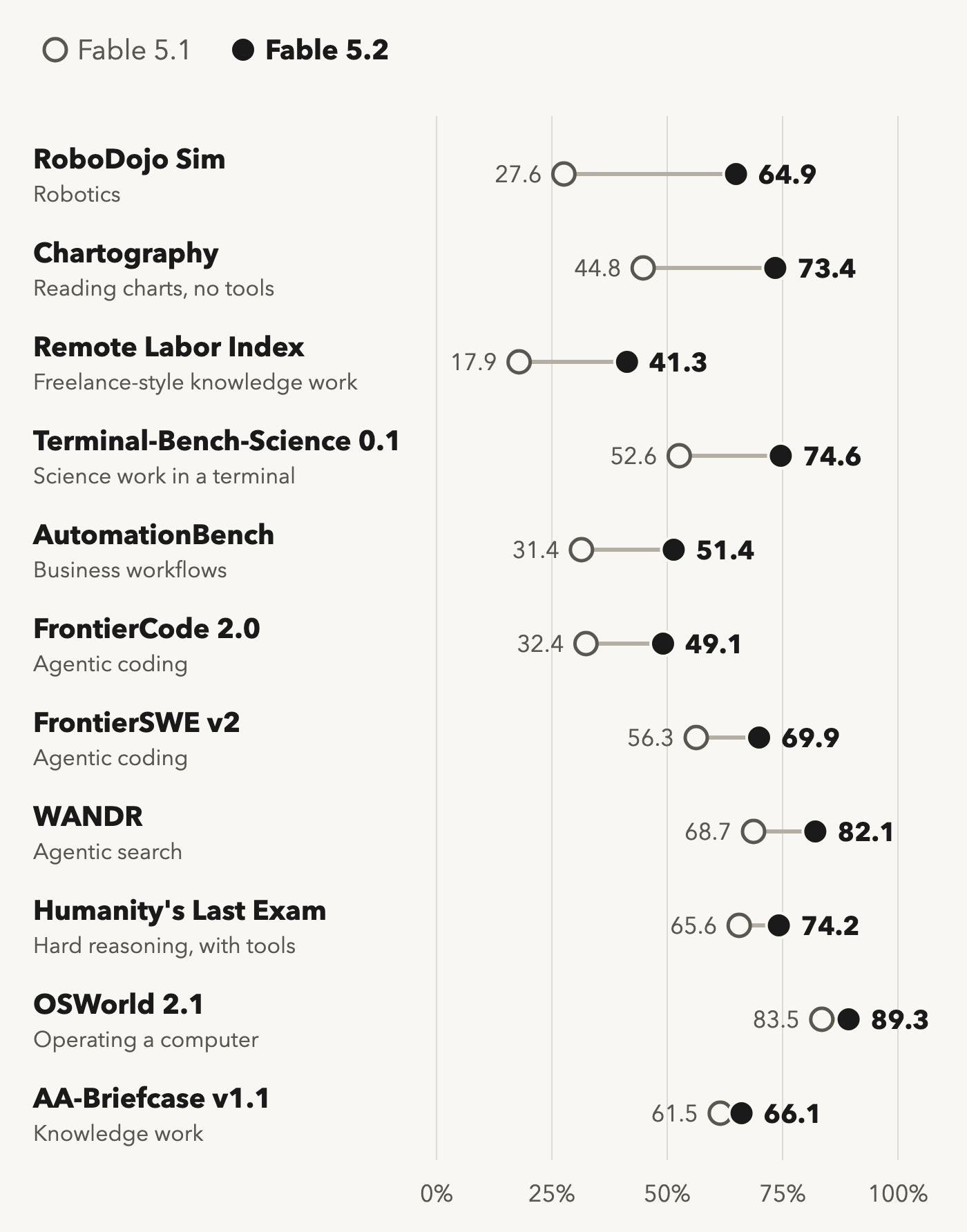
Two of these tests reach back another generation. On AutomationBench, the line has gone from 17.1% on Fable 5 in June to 31.4% on Fable 5.1 and 51.4% now. On Terminal-Bench-Science 0.1, it went from 24.7% to 52.6% to 74.6%. Both scores have roughly tripled in five months.
The smallest moves came on the tests closest to knowledge and reasoning. Humanity's Last Exam with tools rose 8.6 points and AA-Briefcase 4.6, much as the 5.1 release moved knowledge tests least and long, tool-driven work most.
Fable 5.2 Leads Its Rivals on Every Benchmark but One
Anthropic's launch table also compares Fable 5.2 with OpenAI's GPT-6 Astra and Google's Gemini 4 Carbon, alongside Claude Opus 5.5. These are Anthropic's own runs, mostly at each model's highest available effort, so they're the company's claims until independent evaluators publish their own.
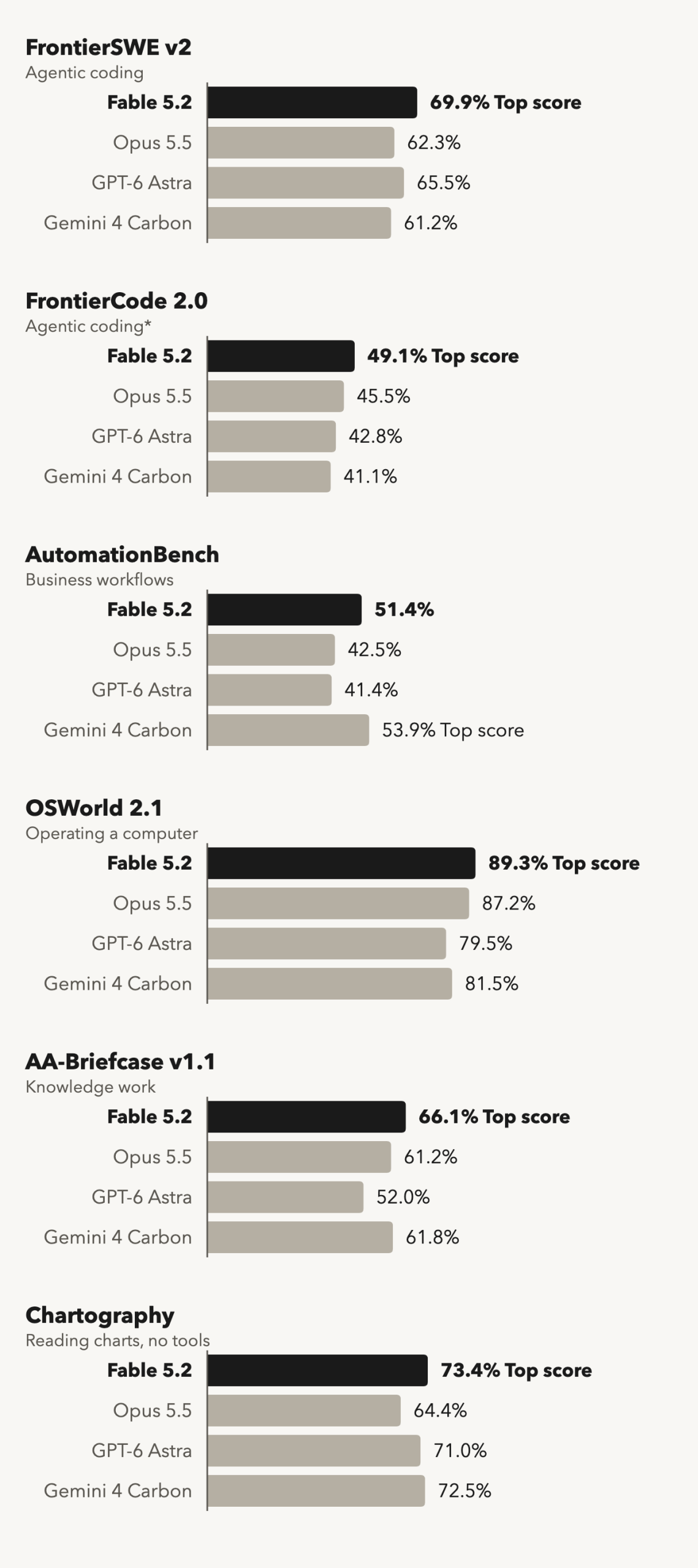
*Gemini 4 Carbon's FrontierCode score was run at medium effort.
| Benchmark | Fable 5.2 | Fable 5.1 | Opus 5.5 | GPT-6 Astra | Gemini 4 Carbon |
|---|---|---|---|---|---|
| FrontierSWE v2 (agentic coding) | 69.9% | 56.3% | 62.3% | 65.5% | 61.2% |
| FrontierCode 2.0 (agentic coding) | 49.1% | 32.4% | 45.5% | 42.8% | 41.1% |
| AutomationBench (business workflows) | 51.4% | 31.4% | 42.5% | 41.4% | 53.9% |
| OSWorld 2.1 (operating a computer) | 89.3% | 83.5% | 87.2% | 79.5% | 81.5% |
| AA-Briefcase v1.1 (knowledge work) | 66.1% | 61.5% | 61.2% | 52.0% | 61.8% |
| Chartography (reading charts, no tools) | 73.4% | 44.8% | 64.4% | 71.0% | 72.5% |
Gemini 4 Carbon is the exception, ahead on AutomationBench, the business-workflow test, at 53.9% to Fable's 51.4%. Neither rival was scored on every row of Anthropic's table. Figures come from Anthropic's announcement.
A Higher Token Price Can Still Mean a Cheaper Job
For anyone paying the bill, Anthropic's cost-per-task figures say more than the scores. Fable 5.2 charges twice what Opus 5.5 does per token, but it often needs far fewer tokens to finish. Anthropic says Fable 5.2 at high effort roughly matches Opus 5.5's best FrontierCode result at about half the cost per task. On Humanity's Last Exam at low effort, it matches Opus 5.5's top score for under a tenth of the cost.
That turns the effort setting into the main cost control. Medium is the default in the Claude apps and Claude Code, and the API defaults to high. Running a hard task at a lower effort on the stronger model can beat running it at maximum effort on the cheaper one, which is a different calculation from comparing price sheets.
Anthropic Still Points Most Work at Opus 5.5
The release doesn't change Anthropic's default. Its guidance is to start with Opus 5.5 for most coding and knowledge work, move up to Fable or Mythos for the most ambitious open-ended technical problems and drop to Sonnet 5.5 or Haiku 5.5 when a task is small. Dianne Penn, Anthropic's head of product management for research, told CNBC that Fable 5.2 is for power users and named engineering, mathematics and robotics as the hard problems it's built for.
- Claude Opus 5.5$4 per million input tokens and $20 per million output. Anthropic's recommended default for writing, research, analysis and most coding.
- Claude Fable 5.2$8 and $40. Long agent jobs and hard reasoning, and it can advise or direct smaller models on the same task.
- Claude Sonnet 5.5$2 and $10. Faster and a quarter of Fable's price, for routine work that doesn't need the top tier.
- Claude Haiku 5.5From $0.10 and $0.50. High-volume classification, extraction and routing.
- Claude Mythos 5.2The same $8 and $40, for vetted organizations only. Security research and life sciences work that Fable's safeguards would block.
Anthropic describes two ways to combine them. As an advisor, Fable 5.2 is consulted by a smaller Haiku, Sonnet or Opus model when that model reaches a hard step. As an orchestrator, it splits a large job and hands the simpler pieces to cheaper models. Either way most of the tokens are spent on the less expensive tiers.
On paid Claude plans, Fable can use up to half of the weekly usage limit on Pro plans and standard Team seats. Eligible subscribers also get one to three Fable usage resets this week, depending on how long they've subscribed.
The Safeguards Block Less Than They Did in September
Fable 5.2 refuses high-risk cybersecurity tasks and most research-level biology. A declined request doesn't simply end: it falls back to an older model, Claude Opus 4.8 for cyber and Claude Opus 5 for biology. Anthropic says the safeguards now block about 55% less often than Fable 5.1's did, with about 60% fewer blocks in cyber and 40% fewer in biology. That matters to anyone whose ordinary security, IT or health content tripped the old filters.
Anthropic also trained Fable 5.2 to hold back in two areas of AI research, accelerator kernel optimization and language model architecture, leaving it near Opus 5.5 there. It says agentic coding, hardware design and general machine learning research weren't affected.
Mythos 5.2 is the strongest security model Anthropic sells. On an internal test against 1,829 known vulnerabilities, it found 10.2% more than Opus 5.5 and 14.4% more than Mythos 5.1, and Mozilla reports it roughly doubled Mythos 5.1's discovery numbers in its own scanning. Anthropic adds that on its own evaluations, identifying vulnerabilities is roughly level with Opus 5.5.
What the System Card Says About Testing
The safety findings are less tidy than the benchmark table. Anthropic says both models voice suspicion that they're being evaluated more often than any of its recent models, which makes it harder to predict how they'll behave outside a test. TechCrunch reports the system card also finds Mythos 5.2 has stronger covert capabilities than earlier Claude models on several evaluations, particularly when its reasoning is hidden from the monitor. Anthropic maintains it can't act covertly against its user.
Other results moved the right way. Across more than 1,800 adversarial sandbox scenarios, Mythos 5.2 used planted credentials or files 3.1% of the time, against 21% for Mythos 5.1 and 39% for Mythos 5. On an automated behavioral audit of about 1,900 scenarios, where lower is better, it scored 2.67 to Opus 5.5's 2.79. The UK AI Security Institute, METR and Frontier Design tested the model before release, though Anthropic notes they didn't review its announcement or system card. Anthropic rates the risk of high-stakes misaligned behavior as low.
The timing drew attention too. Anthropic filed its S-1 for an initial public offering on October 26, and CNBC reports the offering could come as soon as next week. It's also the company's first frontier release since CEO Dario Amodei called in September for slowing the pace of AI development.
Data Retention Is the Setting to Check First
Fable 5.2 and Mythos 5.2 require 30-day data retention for safety monitoring, because some misuse only shows up across many requests. Eligible organizations can keep zero data retention through Enterprise Frontier Safeguards, a private beta that runs the monitoring on data stored in the customer's own infrastructure. Anthropic names Bridgewater, Salesforce and Stripe among its users.
For a company that puts client files, contracts or customer records into Claude, the retention terms are worth confirming before anyone switches models. A team on zero data retention today can't move to Fable 5.2 by changing a setting.
What It Changes for Marketing and Web Teams
Everything above is from Anthropic's materials and launch coverage. What follows is our read.
For most marketing work, Anthropic's own guidance holds. Opus 5.5 at half Fable's token price is the sensible default for drafting, editing, research summaries and everyday analysis. Fable 5.2 earns its price on long jobs where many steps have to hold together: a technical audit of a large site, reconciling analytics exports from several platforms or rebuilding part of a site in code. Those are the tasks where its benchmark gains are largest and where the cost per task can favor it.
Research accuracy is the other reason to try it. Testers kept returning to its restraint. Cognition wrote that it "says it doesn't know things instead of hallucinating," and Balyasny Asset Management praised it for not overstating evidence. For a brand publishing claims under its own name, a model that flags what it can't confirm saves an editing pass. Someone still has to check the sources.
The website argument we made when Fable 5.1 shipped still stands: more of a company's site is being read by software working through a task, and that software needs the facts in the page's own text. A faster, cheaper version of the same model lowers the cost of that kind of reading.
How 5.2 Fits the Fable and Mythos Line
Anthropic disclosed Claude Mythos Preview on April 7, 2026, to a restricted group of companies under Project Glasswing. Mythos 5 and Fable 5 followed on June 9, Fable being the version with extended safeguards. Access was suspended after a June 12 government letter and restored on July 1. Mythos 5.1 and Fable 5.1 arrived on September 1, and 5.2 came ten weeks later.
Fable 5 and Fable 5.1 both cost $10 and $50 per million tokens, so 5.2 is the first price cut in the line. Fable 5.1 remains available. Anthropic commits to keeping Fable 5.2 available until at least November 9, 2027.
Frequently Asked Questions
What Is Claude Fable 5.2?
Anthropic's most capable widely released model, launched November 9, 2026, for long, multi-step technical work. It has a one-million-token context window and is available on paid Claude plans, in Claude Code, through the Claude API as claude-fable-5-2 and on AWS, Google Cloud and Microsoft Azure.
What's the Difference Between Fable 5.2 and Mythos 5.2?
They're the same underlying model. Fable 5.2 adds safeguards that block high-risk cybersecurity tasks and most research biology, so it's open to everyone. Mythos 5.2 is limited to organizations vetted through Anthropic's Cyber and Life Sciences Verification Programs, plus Enterprise customers using Claude Security.
How Much Does Claude Fable 5.2 Cost?
$8 per million input tokens and $40 per million output tokens, down from $10 and $50 for Fable 5.1. Cached input costs $0.20 per million, batch processing runs at half price and fast mode doubles the standard rate.
Should We Use Fable 5.2 or Opus 5.5?
Start with Opus 5.5, which Anthropic recommends for most coding and knowledge work at half the token price. Move a task to Fable 5.2 when it runs for hours across many steps or Opus 5.5 falls short at high effort, and compare the cost per finished task rather than the price per token.